Scary Story Where a Doctor Comes and Visits a Family Over and Over Again Until Father Deals With Him
| Laura Ingalls Wilder | |
|---|---|
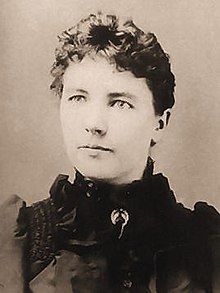 Laura Ingalls Wilder, circa 1885 | |
| Born | Laura Elizabeth Ingalls (1867-02-07)Feb 7, 1867 Pepin County, Wisconsin, U.Due south. |
| Died | February 10, 1957(1957-02-10) (anile 90) Mansfield, Missouri, U.Due south. |
| Resting place | Mansfield Cemetery, Mansfield, Missouri, U.S. |
| Occupation |
|
| Period | 1911–1957 (as a author) |
| Genre | Diaries, essays, family saga (children's historical novels) |
| Subject | Midwestern and Western |
| Notable works |
|
| Notable awards | Laura Ingalls Wilder Medal est. 1954 |
| Spouse | Almanzo Wilder (thou. 1885; died 1949) |
| Children | ii, including Rose Wilder Lane |
| Parents |
|
| Relatives |
|
| Signature |  |
Laura Elizabeth Ingalls Wilder (February 7, 1867 – February ten, 1957) was an American writer, mostly known for the Piddling Firm on the Prairie series of children's books, published between 1932 and 1943, which were based on her babyhood in a settler and pioneer family.[1]
During the 1970s and early 1980s, the television series Petty House on the Prairie was loosely based on the Petty House books, and starred Melissa Gilbert as Laura and Michael Landon as her male parent, Charles Ingalls.[2]
Nascence and beginnings [edit]
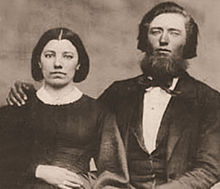
Caroline and Charles Ingalls
Laura Elizabeth Ingalls was born to Charles Phillip and Caroline Lake (née Quiner) Ingalls on Feb vii, 1867. At the time of Ingalls' birth, the family lived vii miles north of the village of Pepin, Wisconsin, in the Big Woods region of Wisconsin. Ingalls' home in Pepin became the setting for her outset volume, Little House in the Large Woods (1932). [3] She was the second of five children, following older sister, Mary Amelia.[four] [v] [6] [7] Three more children would follow, Caroline Celestia (Carrie), Charles Frederick, who died in infancy, and Grace Pearl. Ingalls Wilder'southward birth site is commemorated by a replica log cabin at the Little Business firm Wayside in Pepin.[8]
Ingalls was a descendant of the Delano family, the ancestral family of U.Due south. President Franklin Delano Roosevelt.[9] [10] One paternal antecedent, Edmund Ingalls, from Skirbeck, Lincolnshire, England, emigrated to America, settling in Lynn, Massachusetts.[9]
Laura is the seventh great granddaughter of the Mayflower passenger Richard Warren.[11] She was a third cousin, once removed, of U.S. President Ulysses S. Grant.[12]
Early life [edit]
When she was ii years sometime, Ingalls Wilder moved with her family from Wisconsin in 1869. After stopping in Rothville, Missouri, they settled in the Indian land of Kansas, near modern-twenty-four hours Independence, Kansas. Her younger sis, Carrie, was built-in in Independence in Baronial 1870, not long before they moved again. According to Ingalls Wilder, her father Charles Ingalls had been told that the location would be open up to white settlers, just when they arrived this was not the example. The Ingalls family had no legal right to occupy their homestead because it was on the Osage Indian reservation. They had just begun to subcontract when they heard rumors that settlers would be evicted, so they left in the leap of 1871. Although in her novel, Little House on the Prairie, and Pioneer Daughter memoir, Ingalls Wilder portrayed their deviation as being prompted by rumors of eviction, she also noted that her parents needed to recover their Wisconsin land because the buyer had not paid the mortgage.[thirteen]
The Ingalls family unit went back to Wisconsin where they lived for the next three years. Those experiences formed the basis for Wilder's novels Little House in the Big Woods (1932) and the beginning of Little House on the Prairie (1935).
On the Banks of Plum Creek (1939), the third volume of her fictionalized history which takes identify around 1874, the Ingalls family moves from Kansas to an area near Walnut Grove, Minnesota, settling in a dugout on the banks of Plum Creek.[14]

Laura Ingalls Wilder dugout location
They moved at that place from Wisconsin when Ingalls was about seven years old, after briefly living with the family of her uncle, Peter Ingalls, first in Wisconsin and then on rented land about Lake Urban center, Minnesota. In Walnut Grove, the family unit first lived in a dugout sod house on a preemption claim; after wintering in information technology, they moved into a new business firm built on the same land. Two summers of ruined crops led them to move to Iowa. On the way, they stayed again with Charles Ingalls' brother, Peter Ingalls, this fourth dimension on his farm near South Troy, Minnesota. Her blood brother, Charles Frederick Ingalls ("Freddie"), was born in that location on November 1, 1875, dying nine months later in Baronial 1876. In Burr Oak, Iowa, the family helped run a hotel. The youngest of the Ingalls children, Grace, was born at that place on May 23, 1877.
The family moved from Burr Oak back to Walnut Grove where Charles Ingalls served as the town butcher and justice of the peace. He accepted a railroad job in the jump of 1879, which took him to eastern Dakota Territory, where they joined him that autumn. Ingalls Wilder omitted the period in 1876–1877 when they lived near Burr Oak, skipping to Dakota Territory, portrayed in By the Shores of Silver Lake (1939).
De Smet [edit]
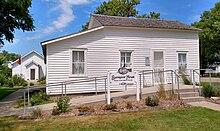
Surveyor's Business firm, the first dwelling house in Dakota Territory of the Charles Ingalls family – De Smet, Southward Dakota
Wilder'south begetter filed for a formal homestead over the winter of 1879–1880.[15] De Smet, South Dakota, became her parents' and sister Mary, who was blind, home for the remainder of their lives. Afterwards spending the mild winter of 1879–1880 in the surveyor's firm, they watched the boondocks of De Smet rise up from the prairie in 1880. The following winter, 1880–1881, i of the nearly severe on record in the Dakotas, was afterward described by Ingalls Wilder in her novel, The Long Winter (1940). In one case the family unit was settled in De Smet, Ingalls attended school, worked several role-fourth dimension jobs, and fabricated friends. Amongst them was bachelor homesteader Almanzo Wilder. This time in her life is documented in the books Fiddling Town on the Prairie (1941) and These Happy Golden Years (1943).
Immature teacher [edit]
On Dec 10, 1882, 2 months earlier her 16th birthday, Ingalls accustomed her first teaching position.[sixteen] She taught three terms in one-room schools when she was not attention schoolhouse in De Smet. (In Little Town on the Prairie she receives her first didactics certificate on December 24, 1882, but that was an enhancement for dramatic effect.[ commendation needed ]) Her original "Third Course" instruction certificate can be seen on page 25 of William Anderson'south book Laura's Album (1998).[17] She later admitted she did not specially bask information technology, but felt a responsibility from a young age to help her family unit financially, and wage-earning opportunities for women were limited. Between 1883 and 1885, she taught three terms of school, worked for the local dressmaker, and attended high school, although she did non graduate. (According to the books, this was due to her first education job starting before her schooling finished. )
Early marriage years [edit]

Rose Wilder Lane birthplace roadside marking – De Smet

Laura and Almanzo Wilder, circa 1885
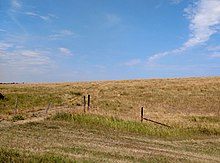
Location of Wilder homestead where both of Wilder'southward children were built-in – De Smet
Ingalls' teaching career and studies ended when the 18-year-old Laura married 28-year-old Almanzo Wilder on August 25, 1885, in De Smet, South Dakota.[18] [19] From the beginning of their relationship, the pair had nicknames for each other: she called him "Manly" and he, considering he had a sister named Laura, called her "Bess", from her heart name, Elizabeth.[19] Almanzo had accomplished a caste of prosperity on his homestead claim;[20] the newly married couple started their life together in a new home, north of De Smet.[21]
On December 5, 1886, Wilder gave nascence to her daughter, Rose. In 1889, she gave nascence to a son who died at 12 days of historic period before being named. He was cached at De Smet, Kingsbury County, South Dakota.[22] [23] On the grave marking, he is remembered every bit "Infant Son of A. J. Wilder".[24]
Their first few years of matrimony were difficult. Complications from a life-threatening bout of diphtheria left Almanzo partially paralyzed. Although he eventually regained about full use of his legs, he needed a cane to walk for the residuum of his life. This setback, among many others, began a serial of unfortunate events that included the death of their newborn son, the destruction of their befouled forth with its hay and grain by a mysterious fire,[25] the total loss of their dwelling from a fire accidentally gear up by Rose,[26] and several years of severe drought that left them in debt, physically ill, and unable to earn a living from their 320 acres (129.v hectares) of prairie land. These trials were documented in Wilder's book The First Four Years (published in 1971). Around 1890, they left De Smet and spent about a year resting at the home of Almanzo'due south parents on their Spring Valley, Minnesota, farm before moving briefly to Westville, Florida, in search of a climate to improve Almanzo's health. They found, however, that the dry plains they were used to were very different from the humidity they encountered in Westville. The weather, along with feeling out of place among the locals, encouraged their return to De Smet in 1892, where they purchased a pocket-size home.[27] [28]
Move to Mansfield, Missouri [edit]
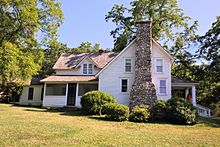
Rocky Ridge Farm, Mansfield, Missouri
In 1894, the Wilders moved to Mansfield, Missouri, and used their savings to make the downwards payment on an undeveloped property just outside town. They named the place Rocky Ridge Farm[29] and moved into a ramshackle log cabin. At first, they earned income only from wagon loads of fire wood they would sell in town for fifty cents. Financial security came slowly. Apple trees they planted did not conduct fruit for seven years. Almanzo'due south parents visited around that time and gave them the deed to the house they had been renting in Mansfield, which was the economical boost Wilder's family needed. They then added to the property outside boondocks, and eventually accrued nearly 200 acres (80.9 hectares). Around 1910, they sold the house in town, moved back to the farm, and completed the farmhouse with the proceeds. What began as about 40 acres (xvi.2 hectares) of thickly wooded, stone-covered hillside with a windowless log cabin became in 20 years a relatively prosperous poultry, dairy, and fruit subcontract, and a 10-room farmhouse.[30]
The Wilders had learned from cultivating wheat as their sole crop in De Smet. They diversified Rocky Ridge Farm with poultry, a dairy farm, and a large apple orchard. Wilder became active in diverse clubs and was an advocate for several regional farm associations. She was recognized equally an authorization in poultry farming and rural living, which led to invitations to speak to groups around the region.[31]
Writing career [edit]
An invitation to submit an commodity to the Missouri Ruralist in 1911 led to Wilder's permanent position as a columnist and editor with that publication, which she held until the mid-1920s. She also took a paid position with the local Farm Loan Association, dispensing small loans to local farmers.
Wilder'due south column in the Ruralist, "As a Farm Woman Thinks", introduced her to a loyal audience of rural Ozarkians, who enjoyed her regular columns. Her topics ranged from habitation and family, including her 1915 trip to San Francisco, California, to visit Rose Lane and the Pan-Pacific exhibition, to World War I and other globe events, and to the fascinating world travels of Lane as well every bit her own thoughts on the increasing options offered to women during this era. While the couple were never wealthy until the "Little House" books began to achieve popularity, the farming operation and Wilder's income from writing and the Farm Loan Association provided them with a stable living.
"[Past] 1924", co-ordinate to the Professor John E. Miller, "[a]fter more than a decade of writing for subcontract papers, Wilder had go a disciplined writer, able to produce thoughtful, readable prose for a general audience." At this fourth dimension, her at present-married daughter, Rose Wilder Lane, helped her publish 2 articles describing the interior of the farmhouse, in Country Gentleman magazine.[32]
Information technology was too around this fourth dimension that Lane began intensively encouraging Wilder to improve her writing skills with a view toward greater success equally a writer than Lane had already achieved.[33] The Wilders, co-ordinate to Miller, had come to "[depend] on annual income subsidies from their increasingly famous and successful girl." They both had ended that the solution for improving their retirement income was for Wilder to get a successful writer herself. Nonetheless, the "project never proceeded very far."[34]
In 1928, Lane hired out the construction of an English-style stone cottage for her parents on belongings adjacent to the farmhouse they had personally congenital and still inhabited. She remodeled and took it over.[35]
Picayune House books [edit]
- Little House in the Big Woods
- Farmer Boy
- Little House on the Prairie
- On the Banks of Plum Creek
- By the Shores of Silvery Lake
- The Long Winter
- Little Town on the Prairie
- These Happy Gold Years
- The First Iv Years
The Stock Market Crash of 1929 wiped the Wilders out; Lane'southward investments were devastated too. They still owned the 200-acre (81-hectare) subcontract, but they had invested almost of their savings with Lane's banker. In 1930, Wilder requested Lane's stance virtually an autobiographical manuscript she had written about her pioneering childhood. The Great Depression, coupled with the deaths of Wilder'southward mother in 1924 and her older sister in 1928, seem to accept prompted her to preserve her memories in a life story called Pioneer Girl. She also hoped that her writing would generate some boosted income. The original title of the first of the books was When Grandma Was a Little Girl.[36] On the advice of Lane'due south publisher, she profoundly expanded the story. Every bit a result of Lane's publishing connections as a successful writer and after editing by her, Harper & Brothers published Wilder's book in 1932 every bit Piddling House in the Big Woods. Subsequently its success, she connected writing. The close and often rocky collaboration between her and Lane continued, in person until 1935, when Lane permanently left Rocky Ridge Subcontract, and afterward by correspondence.
The collaboration worked both ways: two of Lane's most successful novels, Permit the Hurricane Roar (1932) and Free State (1938), were written at the same time as the "Footling Business firm" series and basically retold Ingalls and Wilder family tales in an adult format.[37]
[edit]
Some, including Lane's biographer, William Holtz, accept alleged that Wilder'due south girl was her ghostwriter.[38] Existing evidence includes ongoing correspondence between the women about the books' development, Lane's extensive diaries, and Wilder's handwritten manuscripts with edit notations shows an ongoing collaboration between the ii women.[21]
Miller, using this record, describes varying levels of involvement by Lane. Footling House in the Big Woods (1932) and These Happy Golden Years (1943), he notes, received the least editing. "The starting time pages ... and other large sections of [Big Woods]", he observes, "stand largely intact, indicating ... from the showtime ...[Laura's] talent for narrative clarification."[39] Some volumes saw heavier participation by Lane,[twoscore] while The Offset Four Years (1971) appears to be exclusively a Wilder work.[41] Concludes Miller, "In the end, the lasting literary legacy remains that of the mother more that of the girl ... Lane possessed style; Wilder had substance."[37]
The controversy over authorship is frequently tied to the movement to read the Trivial House series through an ideological lens. Lane emerged in the 1930s as an avowed conservative polemicist and critic of the Franklin D. Roosevelt administration and his New Bargain programs. According to a 2012 commodity in the New Yorker, "When Roosevelt was elected, she noted in her diary, 'America has a dictator.' She prayed for his assassination, and considered doing the task herself."[42] Whatever Lane'southward politics, "attacks on [Wilder'due south] authorship seem aimed at infusing her books with ideological passions they just don't have."[43]
On the topic of historical fiction and its influence on modern views of race relations, literary scholar Rachelle Kuehl notes that Laura Ingalls Wilder'south Little House series has received backlash for her problematic portrayal of Native Americans.[44] They have also been the subject field of postcolonial writing including Kathy Jetnil-Kijiner'south "To Laura Ingalls Wilder" included in her 2017 collection Iep Jaltok: Poems from a Marshallese Daughter.
Enduring appeal [edit]
The original Little House books, written for elementary school–historic period children, became an enduring, eight-volume tape of pioneering life tardily in the 19th century based on the Ingalls family's experiences on the American frontier. Equally Irene Smith pointed out shortly after "These Happy Golden Years (1943) was published, Wilder began "with a style appealing to the eight-twelvemonth-olds and continuing in volumes of increasing length and difficulty. This graduation is a distinguishing characteristic of the Little Firm books."[45] The First 4 Years, about the early days of the Wilder marriage, was discovered by her literary executor Roger MacBride after Lane'south 1968 death and published in 1971, unedited by Lane or MacBride. Information technology is now marketed as the ninth volume.[41]
Since the publication of Little Firm in the Big Woods (1932), the books have been continuously in impress and have been translated into xl other languages. Wilder's beginning—and smallest—royalty check from Harper, in 1932, was for $500, equivalent to $9,930 in 2021. By the mid-1930s the royalties from the Little House books brought a steady and increasingly substantial income to the Wilders for the first time in their l years of marriage. The collaboration as well brought the two writers at Rocky Ridge Farm the money they needed to recoup the loss of their investments in the stock market. Various honors, huge amounts of fan mail service, and other accolades were bestowed on Wilder.[ citation needed ]
Autobiography: Pioneer Girl [edit]
In 1929–1930, already in her early 60s, Wilder began writing her autobiography, titled Pioneer Girl. It was rejected by publishers. At Lane'south urging, she rewrote most of her stories for children. The result was the Fiddling House series of books. In 2014, the South Dakota State Historical Society published an annotated version of Wilder's autobiography, titled Pioneer Girl: The Annotated Autobiography.[46] [47]
Pioneer Girl includes stories that Wilder felt were inappropriate for children: e.thou., a homo accidentally immolating himself while drunk, and an incident of extreme violence of a local shopkeeper against his wife, which ended with his setting their house on fire. She likewise describes previously unknown facets of her begetter'southward character. According to its publisher, "Wilder's fiction, her autobiography, and her existent babyhood are all distinct things, but they are closely intertwined." The volume'south aim was to explore the differences, including incidents with conflicting or non-existing accounts in one or another of the sources.[48]
Political views [edit]
Wilder has been referred to by some as one of America's first libertarians.[49] She was a longtime Democrat, simply became dismayed with Roosevelt's New Deal and what she and her daughter, Rose Wilder Lane, saw every bit Americans' increasing dependence on the federal government. Wilder grew disenchanted with her political party and resented government agents who came to farms like hers and grilled farmers about the number of acres they were planting.[50] Her daughter was similarly a strong libertarian.[51] [50] [52]
Wilder supported women's rights (though she worried that women would vote according to what their husbands wanted, and non as they wanted)[53] and education reform.[53] She also became infamous for a brusk period for shaking the hand of an African American man, which was controversial for segregated Missouri.[53] Indeed, part of the plot of Lilliputian House on the Prairie involves an African American doc saving the Ingalls family's lives.[54]
Later life and death [edit]
Upon Lane'southward departure from Rocky Ridge Farm, Laura and Almanzo moved back into the farmhouse they had built, which had most recently been occupied past friends.[35] From 1935 on, they were alone at Rocky Ridge Farm. About of the surrounding area (including the belongings with the rock cottage Lane had built for them) was sold, only they still kept some farm animals, and tended their flower beds and vegetable gardens. Almost daily, carloads of fans stopped past, eager to run across the "Laura" of the Footling House books.
The Wilders lived independently and without financial worries until Almanzo's decease at the farm in 1949 at age 92. Wilder remained on the farm. For the next eight years, she lived alone, looked after by a circle of neighbors and friends. She continued an active correspondence with her editors, fans, and friends during these years.

Gravesite of Laura Ingalls Wilder and husband Almanzo Wilder at Mansfield Cemetery, Mansfield, Missouri. Buried adjacent to them is daughter Rose Wilder Lane.
In autumn 1956, 89-year-quondam Wilder became severely ill from undiagnosed diabetes and cardiac problems. She was hospitalized by Lane, who had arrived for Thanksgiving. She was able to return home on the 24-hour interval after Christmas. However, her wellness declined after her release from the infirmary, and she died at abode in her sleep on Feb 10, 1957, three days after her 90th birthday.[55] She was cached beside Almanzo at Mansfield Cemetery in Mansfield. Lane was cached next to them upon her death in 1968.[56]
Estate [edit]
Following Wilder's death, possession of Rocky Ridge Farm passed to the farmer who had before bought the property under a life lease arrangement.[57] [58] The local population put together a non-profit corporation to buy the house and its grounds for use as a museum.[59] Afterward some wariness at the notion of seeing the firm rather than the books be a shrine to Wilder, Lane came to believe that making a museum of it would draw long-lasting attending to the books. She donated the money needed to buy the house and make information technology a museum, agreed to brand significant contributions each twelvemonth for its budget, and donated many of her parents' belongings.[60]
In compliance with Wilder'southward will, Lane inherited ownership of the Little House literary estate, with the stipulation that it be for only her lifetime, with all rights reverting to the Mansfield library after her death. Following her demise in 1968, nevertheless, her called heir, Roger MacBride, gained control of the books' copyrights.[61] too as her business concern agent and lawyer. The copyrights to each of Wilder's "Lilliputian House" books, likewise equally those of Lane's own literary works, were renewed in his proper noun later on the original copyright had expired.[62] [63]
Controversy arose following MacBride's death in 1995, when the Laura Ingalls Wilder Co-operative of the Wright County Library in Mansfield—the library founded in office by Wilder—tried to recover the rights to the series. The ensuing court case was settled in an undisclosed manner, with MacBride'south heirs retaining the rights to Wilder's books. From the settlement, the library received plenty to start work on a new edifice.[64] [65]
The popularity of the Little House books has grown over the years following Wilder'south decease, spawning a multimillion-dollar franchise of mass merchandising under MacBride's impetus.[66] Results of the franchise take included boosted spinoff book series[ citation needed ]—some written by MacBride and his girl, Abigail—and the long-running television serial, starring Melissa Gilbert every bit Wilder and Michael Landon equally her begetter.
Works [edit]
Because she died in 1957, Wilder'southward works are now public domain in countries where the term of copyright lasts 50 years later the writer's death, or less; generally this does not include works first published posthumously. Works kickoff published earlier 1924 or where copyright was non renewed, primarily her newspaper columns, are also public domain in the United States.[ citation needed ]
Picayune Firm books [edit]
The viii "original" Little House books were published past Harper & Brothers with illustrations past Helen Sewell (the first three) or by Sewell and Mildred Boyle.
- Little House in the Big Wood (1932) – named to the inaugural Lewis Carroll Shelf Award listing in 1958
- Farmer Boy (1933) – about Almanzo Wilder growing upwards in New York
- Little House on the Prairie (1935)
- On the Banks of Plum Creek (1937)[a]
- Past the Shores of Silver Lake (1939)[a]
- The Long Winter (1940)[a]
- Piffling Town on the Prairie (1941)[a]
- These Happy Golden Years (1943)[a]
Other works [edit]
- On the Manner Home (1962, published posthumously) – diary of the Wilders' move from De Smet, South Dakota, to Mansfield, Missouri, edited and supplemented by Rose Wilder Lane[67]
- The First 4 Years (1971, published posthumously past Harper & Row), illustrated past Garth Williams – commonly considered the 9th Little House book
- West from Home (1974, published posthumously), ed. Roger Lea MacBride – Wilder'southward letters to Almanzo while visiting her daughter Rose Wilder-Lane in 1915 in San Francisco[68]
- Little House in the Ozarks: The Rediscovered Writings (1991)[69] LCCN 91-10820 – collection of pre-1932 articles[70]
- The Road Back Domicile, part three (the only part previously unpublished) of A Little House Traveler: Writings from Laura Ingalls Wilder's Journeys Across America (2006, Harper) LCCN 2005-14975 – Wilder's tape of a 1931 trip with Almanzo to De Smet, Due south Dakota, and the Black Hills
- A Little House Sampler (1988 or 1989, U. of Nebraska), with Rose Wilder Lane, ed. William Anderson, OCLC 16578355[71]
- Writings to Immature Women – Volume 1: On Wisdom and Virtues, Volume Two: On Life as a Pioneer Woman, Volume Iii: Equally Told past Her Family unit, Friends, and Neighbors [72]
- A Lilliputian House Reader: A Collection of Writings (1998, Harper), ed. William Anderson[71]
- Laura Ingalls Wilder & Rose Wilder Lane, 1937–1939 (1992, Herbert Hoover Presidential Library), ed. Timothy Walch – selections from messages exchanged by Wilder and Lane, with family unit photographs, OCLC 31440538
- Laura's Anthology: A Remembrance Scrapbook of Laura Ingalls Wilder (1998, Harper), ed. William Anderson, OCLC 865396917
- Pioneer Girl: The Annotated Autobiography (South Dakota Historical Society Press, 2014)[46]
- Before the Prairie Books: The Writings of Laura Ingalls Wilder 1911–1916: The Modest Subcontract [ citation needed ]
- Earlier the Prairie Books: The Writings of Laura Ingalls Wilder 1917–1918: The State of war Years [ citation needed ]
- Earlier the Prairie Books: The Writings of Laura Ingalls Wilder 1919–1920: The Farm Home [ citation needed ]
- Before the Prairie Books: The Writings of Laura Ingalls Wilder 1921–1924: A Subcontract Woman [ citation needed ]
- Laura Ingalls Wilder'southward Most Inspiring Writings [ citation needed ]
- Laura Ingalls Wilder: A Pioneer Girl's Earth View: Selected Newspaper Columns (Fiddling House Prairie Series) [ commendation needed ]
- The Selected Messages of Laura Ingalls Wilder, edited by William Anderson[73]
- Laura Ingalls Wilder Farm Journalist: Writings from the Ozarks, edited by Stephen W. Hines[74]
- Laura Ingalls Wilder's Fairy Poems, Introduced and compiled by Stephen W. Hines[75]
Legacy [edit]
Documentary [edit]
Little House on the Prairie: The Legacy of Laura Ingalls Wilder (Feb 2015) is a 1-hr documentary film that looks at the life of Wilder. Wilder'southward story as a writer, married woman, and mother is explored through interviews with scholars and historians, archival photography, paintings by borderland artists, and dramatic reenactments.
Historic sites and museums [edit]

Laura Ingalls Wilder Memorial Gild – De Smet, SD
- Laura Ingalls Wilder House and Museum, Mansfield, Missouri
- Laura Ingalls Wilder Museum, Pepin, Wisconsin[76]
- Laura Ingalls Wilder Museum, Walnut Grove, Minnesota[77]
- Laura Ingalls Wilder Memorial Society museum and historic homes, De Smet, South Dakota; annual pageant performed hither[78] [79] [eighty]
- Laura Ingalls Wilder Park and Museum, Burr Oak, Iowa[81]
- Little House on the Prairie Museum, Independence, Kansas[82]
- Wilder Homestead, Malone, NY[83]
- De Smet Cemetery in Kingsbury County, Southward Dakota, where many Little House Ingalls family members are buried
Portrayals on screen and stage [edit]
Multiple adaptations of Wilder's Lilliputian House on the Prairie book series accept been produced for screen and stage. In them, the post-obit actresses accept portrayed Wilder:
- Melissa Gilbert in the television serial Trivial Firm on the Prairie and its movie sequels (1974–1984)
- Kazuko Sugiyama (voice) in the Japanese anime series Laura, The Prairie Daughter (1975–1976)
- Meredith Monroe, Tess Harper (elder version), Alandra Bingham (younger version, part ane), Michelle Bevan (younger version, part 2) in part 1 and part two of the Beyond the Prairie: The True Story of Laura Ingalls Wilder television films (2000 and 2002)
- Kyle Chavarria in the TV miniseries Piddling House on the Prairie (2005)
- Kara Lindsay in the Little House on the Prairie book musical (2008–2010)
Wilder Medal [edit]
Wilder was five times a runner-up for the annual Newbery Medal, the premier American Library Association (ALA) book award for children's literature.[a] In 1954, the ALA inaugurated a lifetime achievement award for children's writers and illustrators, named for Wilder, of which she was the first recipient. The Laura Ingalls Wilder Medal recognizes a living author or illustrator whose books, published in the United States, have fabricated "a substantial and lasting contribution to literature for children". As of 2013, it has been conferred nineteen times, biennially starting in 2001.[85] In 2018, the award was renamed the Children'due south Literature Legacy Honor in light of linguistic communication in Wilder's works which the Association perceived as biased confronting Native Americans and African Americans.[86]
Other [edit]
- Google Doodle commemorated her 148th birthday in 2015.[87]
- Hall of Famous Missourians at the Missouri State Capitol – a bronze bust depicting Wilder is on permanent display in the rotunda. She was inducted in 1993.
- Missouri Walk of Fame – Wilder was honored on the Walk in 2006.[88]
- Wilder crater on planet Venus was named afterward Wilder.
- In her 1916 essay "Expect for Fairies Now", Wilder asked, "Of what use are eyes to a tree, I wonder?". The following century has seen connected research on the detection of far-reddish receptors by plants, including as a possible factor in crown shyness.
- The Wilder Life: My Adventures in the Lost World of 'Little Firm on the Prairie', 2011 book by Wendy McClure
See also [edit]
References [edit]
Notes [edit]
- ^ a b c d e f V times from 1938 to 1944 Wilder was one of the runners-up for the American Library Association Newbery Medal, recognizing the previous year's "almost distinguished contribution to American literature for children". The honored works were the last five of eight books in the Little House series that were published in her lifetime.[84]
Citations [edit]
- ^ "Laura Ingalls Wilder | Biography, Books, & Facts". Encyclopedia Britannica . Retrieved February 4, 2020.
- ^ Trivial House on the Prairie , retrieved May 14, 2019
- ^ "Laura Ingalls Wilder". wisconsinhistory.org. Wisconsin Historical Society. Archived from the original on February 10, 2007.
- ^ Benge, Janet and Geoff (2005). Laura Ingalls Wilder: A Storybook Life. YWAM Publishing. p. 180. ISBN1-932096-32-9.
- ^ "What Actually Caused Mary Ingalls to Go Blind?". February 4, 2013. American Academy of Pediatrics. Printing release announcing Allexan, et al.:
• Allexan, Sarah Due south.; Byington, Carrie 50.; Finkelstein, Jerome I.; Tarini, Beth A. (March 1, 2013). "Blindness in Walnut Grove: How Did Mary Ingalls Lose Her Sight?". Pediatrics. 131 (iii): 404–06. doi:x.1542/peds.2012-1438. PMC4074664. PMID 23382439. - ^ Dell'Antonia, KJ (February four, 2013). "Cherry-red Fever Probably Didn't Blind Mary Ingalls". The New York Times . Retrieved February iv, 2013.
- ^ Serena, Gordon (February four, 2013). "Mistaken Infection 'On The Prairie'?". HealthDay; U.Due south. News & World Report (usnews.com/wellness-news). Retrieved Feb 4, 2013.
- ^ "Laura.pdf" (PDF). Fiddling Business firm Wayside; Pepin, Wisconsin (visitpepincounty.com). Retrieved February 8, 2015.
- ^ a b Gormley, Myra Vanderpool; Rhonda R. McClure. "A Genealogical Expect at Laura Ingalls Wilder". GenealogyMagazine.com. Archived from the original on October 25, 2014. Retrieved October 25, 2014.
- ^ "Eunice Sleeman". Edmund Rice (1638) Association (edmund-rice.org). 2002. Archived from the original on Feb 26, 2010. Retrieved April 20, 2010.
Eunice Sleeman was the mother of Eunice Blood (1782–1862), the wife of Nathan Colby (built-in 1778), who were the parents of Laura Louise Colby Ingalls (1810–1883), Ingalls' paternal grandmother
- ^ Famous Kin: https://famouskin.com/famous-kin-nautical chart.php?name=9317+richard+warren&kin=12145+laura+ingalls+wilder
- ^ "Famous Descendants". MayflowerHistory.com.
- ^ Kaye, Frances W. (2000). "Petty Squatter on the Osage Diminished Reserve: Reading Laura Ingalls Wilder's Kansas Indians". Slap-up Plains Quarterly. 20 (2): 123–140.
- ^ "Laura Ingalls Wilder Timeline". Laura Ingalls Wilder. The Herbert Hoover Presidential Library and Museum; National Athenaeum and Records Administration (hoover.archives.gov). Archived from the original on Oct 25, 2014. Retrieved Oct 25, 2014.
- ^ "Country Records: Ingalls Homestead File". National Archives. August 15, 2016. Retrieved June xiii, 2019.
- ^ "Laura Ingalls Wilder Timeline". Herbert Hoover Presidential Library & Museum. Herbert Hoover Presidential Library & Museum. Archived from the original on Baronial 14, 2003. Retrieved January 27, 2017.
- ^ Anderson, William (1998). Laura'south Anthology. Harper Collins.
- ^ "Laura Ingalls Wilder Historical Timeline". Dec 28, 2018.
- ^ a b Wilder, Laura Ingalls; Wilder, Almanzo (1974). West from Home: Letters of Laura Ingalls Wilder, San Francisco, 1915. HarperCollins. p. xvii.
- ^ Ketcham, Sallie (2014). Laura Ingalls Wilder: American Writer on the Prairie. Routledge. ISBN978-1136725739.
- ^ a b Thurman, Judith. "Wilder Women". The New Yorker . Retrieved February 4, 2020.
- ^ "Laura Ingalls Wilder Timeline". hoover.archives.gov. West Co-operative, IA, US: The Herbert Hoover Presidential Library and Museum. Archived from the original on May 25, 2016. Retrieved June 8, 2016.
- ^ "De Smet Info". ingallshomestead.com . Retrieved June 8, 2016.
- ^ "Christian Living: A Magazine for Dwelling house and Community". Mennonite Publishing House. March iii, 1963 – via Google Books.
- ^ Miller 1998, p. fourscore.
- ^ Miller 1998, p. 84.
- ^ "The story behind the stories: Laura Ingalls Wilder's life in Minnesota and across". MinnPost. August 19, 2014. Retrieved February 4, 2020.
- ^ Messud, Claire (April 19, 2018). "Wilder and Wilder". New York Review of Books. ISSN 0028-7504. Retrieved February 4, 2020.
- ^ "Laura's Life on Rocky Ridge Farm". Laura Ingalls Wilder Historic Dwelling & Museum. November 5, 2012. Retrieved Dec 24, 2016.
- ^ Danilov, Victor J. (2013). Famous Americans: A Directory of Museums, Historic Sites, and Memorials. Scarecrow Press. ISBN978-0-8108-9186-ix.
- ^ Wilder, Laura Ingalls (2007). Hines, Stephen W. (ed.). Laura Ingalls Wilder, subcontract journalist : writings from the Ozarks. Columbia: Academy of Missouri Press. ISBN978-0826266156. OCLC 427509646.
- ^ Miller 1998, p. 161.
- ^ Miller 1998, p. 162.
- ^ Miller 2008, p. 24.
- ^ a b Miller 1998, p. 177.
- ^ Hines-Dochterman, Meredith (September thirty, 2005). "Students visiting Wilder'south prairie". St. Joseph News-Press.
- ^ a b Miller 2008, p. forty.
- ^ Holtz 1993.[ full citation needed ]
- ^ Miller 1998, pp. half dozen, 190.
- ^ Miller 2008, pp. 37 et seq.
- ^ a b Thurman, Judith (August 10, 2009). "Wilder Women: The mother and daughter behind the Little House stories". The New Yorker . Retrieved Feb 8, 2015.
- ^ Thurman, Judith (August 16, 2012). "A Libertarian House on the Prairie". The New Yorker . Retrieved February 8, 2015.
- ^ Fraser, Caroline (October 10, 2012). "'Petty House on the Prairie': Tea Party manifesto". Los Angeles Review of Books . Retrieved February 8, 2015 – via Salon (salon.com).
- ^ Kuehl, Rachelle (January 2022). "Through Lines: Exploring Past/Present Connections in Eye Grade Novels". The Reading Teacher. 75 (4): 441–451. doi:10.1002/trtr.2041. ISSN 0034-0561.
- ^ Irene Smith, "Laura Ingalls Wilder and The Fiddling House Books", in William Anderson, ed. The Horn Book's Laura Engalls Wilder, The Horn Volume, n.p., 1987, p. 12.
- ^ a b "Pioneer Girl is out!". November 21, 2014. Pioneer Girl Project (pioneergirlproject.org). Southward Dakota Historical Society Printing. Retrieved October 15, 2015.
- ^ Higgins, Jim (December 5, 2014). "Laura Ingalls Wilder's annotated autobiography, 'Pioneer Girl,' shows writer's world, growth". Milwaukee Periodical Scout . Retrieved December 23, 2014.
- ^ Inundation, Alison (August 25, 2014). "Laura Ingalls Wilder memoir reveals truth behind Little House on the Prairie". The Guardian . Retrieved August 26, 2014.
- ^ Boaz, David (May ix, 2015). "The Legacy of Laura Ingalls Wilder, 1 of America's Get-go Libertarians". Fourth dimension . Retrieved June 11, 2019.
- ^ a b Klein, Christopher (Feb 7, 2014). "Picayune Libertarians on the Prairie: The Hidden Politics Behind a Children's Archetype". History.com . Retrieved June xi, 2019.
- ^ Blakemore, Erin (April 8, 2016). "Politics on the Prairie: Laura Ingalls Wilder and Rose Wilder Lane". Daily Jstor . Retrieved June xi, 2019.
- ^ McElroy, Wendy (Apr 2, 2019). "The Picayune Firm on the Prairie of Laura Ingalls Wilder". LewRockwell.com . Retrieved June 11, 2019.
- ^ a b c Wilder, L. I., & In Anderson, W. (2017). The selected letters of Laura Ingalls Wilder.
- ^ Wilder, L. I. (1932). Picayune business firm in the big woods: Trivial house on the prairie. New York: Harper & Row.
- ^ "Laura I. Wilder, Writer, Dies at 90. Writer of the 'Niggling House' Serial for Children Was an Ex-Newspaper Editor. Wrote First Book at 65". The New York Times. Associated Press. Feb 12, 1957. Retrieved Oct 24, 2012.
Mrs. Laura Ingalls Wilder, writer of the 'Piffling House' serial of children's books, died yesterday at her subcontract near hither afterward a long affliction. Her age was 90.
Commodity preview. Article bachelor only by subscription or purchase. (subscription required) - ^ Wilson, Scott (2016). Resting Places: The Burial Sites of More Than fourteen,000 Famous Persons, 3d ed. McFarland. ISBN978-0786479924 – via Google Books.
- ^ McHugh, Catherine. "five Facts Nigh Laura Ingalls Wilder". Biography . Retrieved January fifteen, 2021.
- ^ Holtz 1995, pp. 334, 338.
- ^ "Mansfield Plans Wilder Museum". Springfield News & Leader. February 24, 1957.
- ^ Holtz 1995, p. 340.
- ^ See Carolyn Fraser, Prairie Fires: The American Dreams of Laura Ingalls Wilder. Henry Holt and Co., 2017. Besides see William Holtz, The Ghost in the Little House: A Life of Rose Wilder Lane. Academy of Missouri Press, 1995.
- ^ Richardson, Lynda (November 23, 1999). "Piddling Library On the Offensive". The New York Times. ISSN 0362-4331. Retrieved February 4, 2020.
- ^ See Carolyn Fraser, Prairie Fires: The American Dreams of Laura Ingalls Wilder. Henry Holt and Co., 2017.
- ^ Strait, Jefferson (Apr 28, 2001). "Wilder library on verge of settlement". Springfield News-Leader.
- ^ Levine, Hallie (November 3, 1999). "Lawsuit on the Prairie: Boxing Pits Small Library Confronting Huge Manor". New York Mail . Retrieved February 4, 2020.
- ^ Tharp, Julie; Kleiman, Jeff (2000). ""Petty House on the Prairie" and the Myth of Self-Reliance". Transformations: The Journal of Inclusive Scholarship and Pedagogy. 11 (1): 55–64. ISSN 1052-5017. JSTOR 43587224.
- ^ "On the Style Home: The Diary Of A Trip From S Dakota To Mansfield, Missouri, In 1894". Kirkus Reviews. November 1, 1962. Retrieved Oct 2, 2015.
- ^ "West From Home: Letters Of Laura Ingalls Wilder, San Francisco, 1915". Kirkus Reviews. March i, 1974. Retrieved October 2, 2015.
- ^ Wilder, Laura (1991). Hines, Stephen Due west. (ed.). Little Business firm in the Ozarks: The Rediscovered Writings. Nashville: T. Nelson. ISBN0883659689.
- ^ "Little House in the Ozarks". Kirkus Reviews. July 15, 1991. Retrieved October 2, 2015. "Wilder was an experienced journalist; many of her manufactures, often written for a publication called Farmer's Week, described her life on the subcontract where she and Almanzo had finally settled".
- ^ a b "A Little House Reader: A Collection of Writings by Laura Ingalls Wilder". Kirkus Reviews. December 15, 1997. Retrieved October two, 2015.
- ^ Wilder, Laura Ingalls (2006). Hines, Stephen W. (ed.). Writings to young women from Laura Ingalls Wilder. Nashville, TN: Tommy Nelson. ISBN1400307848. OCLC 62341531.
- ^ "The Selected Letters Of Laura Ingalls Wilder". ingallshomestead.com . Retrieved December 24, 2016.
- ^ "Laura Ingalls Wilder Farm Journalist". ingallshomestead.com . Retrieved Dec 24, 2016.
- ^ Wilder, Laura (1998). Hines, Stephen Due west (ed.). Laura Ingalls Wilder's fairy poems. New York: Bantam Doubleday Dell Pub. Grouping. ISBN978-0385325332. OCLC 37361669.
- ^ "Home". Laura Ingalls Wilder Museum (lauraingallspepin.com). Retrieved February 8, 2015.
- ^ "Laura Ingalls Wilder Museum". Walnut Grove, MN (walnutgrove.org). Retrieved Feb 8, 2015.
- ^ "Ingalls Homestead". Ingalls Homestead.
- ^ Ingalls, Discover Laura. "Tour the original homes of the Ingalls family unit". Laura Ingalls Wilder Historic Homes.
- ^ "Laura Ingalls Wilder Pageant". Laura Ingalls Wilder Pageant.
- ^ "Dwelling house". Laura Ingalls Wilder Park and Museum (lauraingallswilder.us). Retrieved February 24, 2008.
- ^ "Home". Niggling House on the Prairie Museum (littlehouseontheprairiemuseum.com). Retrieved Feb 8, 2015.
- ^ "Wilder Homestead, Boyhood Abode of Almanzo". almanzowilderfarm.com . Retrieved Dec 24, 2016.
- ^ "Newbery Medal and Honor Books, 1922–Present". ALSC. ALA.
"The John Newbery Medal". ALSC. ALA. Retrieved 2013-03-08. - ^ "Laura Ingalls Wilder Award, Past winners". Association for Library Service to Children (ALSC). American Library Clan (ALA).
"About the Laura Ingalls Wilder Award". ALSC. ALA. Retrieved 2013-03-08. - ^ "Association removes Laura Ingalls Wilder's name from award". AP News. Associated Press. June 24, 2018. Retrieved June 25, 2018.
- ^ "Laura Ingalls Wilder's 148th Birthday". Retrieved June ten, 2015.
- ^ "2006". world wide web.cherryblossomfest.com. Retrieved May fourteen, 2019.
Works cited [edit]
- Holtz, William (1993). The Ghost in the Little House: A Life of Rose Wilder Lane . University of Missouri Printing. ISBN0-8262-0887-viii.
- Holtz, William (1995). The Ghost in the Little House: A Life of Rose Wilder Lane. University of Missouri Printing. ISBN0-8262-1015-5. – Edition: illustrated, reprint, revised; 427 pp.; selections and bibliographic data retrieved from Google Books 2015-10-fifteen.
- Miller, John E. (1998). Becoming Laura Ingalls Wilder: The Adult female Backside the Legend . University of Missouri Printing. ISBN0-8262-1167-4.
- Miller, John E. (2008). Laura Ingalls Wilder and Rose Wilder Lane: Authorship, Place, Time, and Culture . University of Missouri Printing. ISBN978-0-8262-1823-0.
Further reading [edit]
- Campbell, Donna (2003). "'Written with a Hard and Ruthless Purpose': Rose Wilder Lane, Edna Ferber, and Middlebrow Regional Fiction". In Botshon, Lisa; Goldsmith, Meredith (eds.). Middlebrow Moderns: Popular American Women Writers of the 1920s. pp. 25–. hdl:2376/5707. ISBN978-ane-55553-556-8.
- Cochran-Smith, Marilyn (2016). "Colour Blindness and Basket Making Are Non the Answers: Against the Dilemmas of Race, Culture, and Language Diversity in Teacher Education". American Educational Research Journal. 32 (3): 493–522. doi:x.3102/00028312032003493. S2CID 146270683.
- Fatzinger, Amy S. (2008). "Indians in the House": Revisiting American Indians in Laura Ingalls Wilder's Lilliputian House Books (PhD Thesis). University of Arizona. hdl:10150/195771.
- Fraser, Caroline (2017). Prairie Fires: The American Dreams of Laura Ingalls Wilder. New York: Metropolitan Books.
- Heldrich, Philip (2000). "'Going to Indian Territory': Attitudes Toward Native Americans in Little House on the Prairie". Great Plains Quarterly. 20 (2): 99–109. JSTOR 23532729.
- Limerick, Patricia Nelson (Nov 20, 2017). "'Lilliputian House on the Prairie' and the Truth Nigh the American Due west". The New York Times.
- Sickels, Amy (2007). Laura Ingalls Wilder . Facts On File. ISBN9781438123783.
- Smulders, Sharon (2002). "'The Only Skillful Indian': History, Race, and Representation in Laura Ingalls Wilder's Little House on the Prairie". Children'due south Literature Clan Quarterly. 27 (4): 191–201. doi:x.1353/chq.0.1688.
- Singer, Amy (2015). "Little Girls on the Prairie and the Possibility of Subversive Reading". Girlhood Studies. 8 (2): 4–20. doi:10.3167/ghs.2015.080202.
- Stewart, Michelle Pagni (2013). "'Counting Insurrection' on Children'due south Literature virtually American Indians: Louise Erdrich's Historical Fiction". Children's Literature Association Quarterly. 38 (ii): 215–35. doi:ten.1353/chq.2013.0019.
External links [edit]
- Laura Ingalls Wilder in MNopedia, the Minnesota Encyclopedia
- Laura Ingalls Wilder at Library of Congress Regime, with 144 catalog records
- Beyond Piddling House – Laura Ingalls Wilder Legacy and Research Association
- Laura Ingalls Wilder, Frontier Girl
- Travel map of Laura Ingalls Wilder – A map showing Laura Ingalls Wilder's travels from her nascence in 1867 to 1894.
- About the Ingalls Family (Sarah Due south. Uthoff)
- Western American Literature Research: Laura Ingalls Wilder
- Laura Ingalls Wilder: An American Fixture (Pamela Smith Hill)
Museums [edit]
- Laura Ingalls Wilder Museum, Walnut Grove, Minnesota:
- Laura Ingalls Wilder Park & Museum, Burr Oak, Iowa
Electronic editions [edit]
- Works past Laura Ingalls Wilder at Faded Page (Canada)
tylorhicaltisee38.blogspot.com
Source: https://en.wikipedia.org/wiki/Laura_Ingalls_Wilder

Post a Comment for "Scary Story Where a Doctor Comes and Visits a Family Over and Over Again Until Father Deals With Him"