Is a Baby Ray's From Visiting Is There a Baby Whale Shark Bigger Than a Great White Shark
Whale Shark
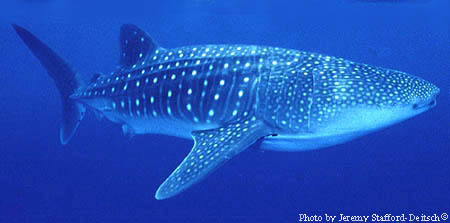
Rhincodon typus
These sharks are recognizable not just for being the largest fish in the body of water, merely likewise for their unique patterns. They are filter feeders, often pond about the surface of the open sea; they gulp in water and filter everything from plankton and fish eggs to crustaceans and schooling fish, to occasional larger casualty similar squid or tuna. Despite their size, they are considered harmless to humans, and will ofttimes interact docilely with divers.
Order – Orectolobiformes
Family – Rhincodontidae
Genus – Rhincodon
Species – typus
Common names
- English: Whale shark
- Afrikaans: walvishaai
- French: requin baleine chagrin
- Gela: bagea ni oka, bahiri
- German: rauhhai,walhai
- Japanese: jinbeizame
- Central khmer: yaak
- Malay: yu paus
- Smoothen: rekin wielorybi
- Portuguese: tubarão baleia
- Spanish: dámero pez dama, tiburon ballena
- Swahili: vaame
- Tagalog: tuko
- Tamil: thimingal sura
- Visayan: tuki-tuki
Importance to Humans
Whale sharks are a part of the national and international trade, keystones of marine tourism, and oftentimes taken as bycatch by fisheries. The only fishery to exist in the Atlantic was in Cuba, which caught most ix sharks annually, and was later on shut downwardly and banned in 1991. Withal, in the Indo-pacific, the corporeality of whale sharks targeted past fisheries has risen over the years because of the increasing economic value of the shark's meat (Chen, 2002).
Until 2008, Taiwan caught an average of 100 whale sharks annually, for meat, oil, fins, or aquaria. Although Whale shark fins are rarely seen on the market when they appear they are highly-priced because of their difficult preparation and trophy-like condition. Because of their value, opportunistic finning began in several countries including India and Taiwan (Chen, 2002). In Bharat, harpooning allowed access to liver oils and flesh of the shark. Even though whale sharks are now protected in India and the Philippines, harpooning fisheries adult in other countries such as Islamic republic of iran and Islamic republic of pakistan (Akhilesh, 2013). The liver oils are often used for waterproofing fishing boats and other appliances, for the industry of shoe smoothen, and as a treatment for some peel diseases, while the mankind is occasionally eaten.
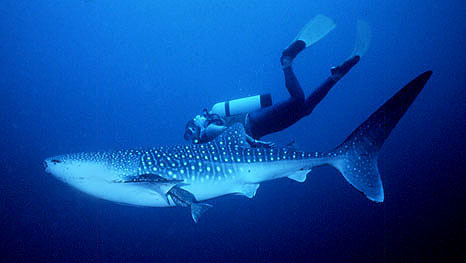
Whale sharks have been kept in specialized aquaria in Japan, China, and in the Georgia Aquarium (U.S.), simply their large size and specialized diet exclude this species from mainstream aquarium species. In a few locations where the presence of whale sharks appears to exist predictable, they are increasingly targeted by commercial tourist operations. By taking advantage of the surface feeding habits of the whale shark, the tourism manufacture has quickly expanded around the world, generating millions of dollars per state annually (Topelko, 2005).
Danger to Humans
By and large considered harmless. All the same, at that place accept been a few cases of whale sharks ramming sportfishing boats, possibly after being provoked. Ordinarily, the sharks are more at risk of being struck accidentally by vessels whilst basking or feeding on the surface.
Conservation
Threats to this species include bycatch, fisheries, vessel strikes, and poorly conducted tourism (Stacey, 2012). The whale shark is listed as "Vulnerable" with the International Union for Conservation of Nature and Natural Resource (IUCN). The whale shark is listed by the AFS (American Fisheries Society) as conservation dependent (reduced but stabilized or recovering under a standing conservation plan) in both the U.S. Atlantic and the Gulf of United mexican states. However, information technology is considered non at risk in the Gulf of California. In the Maldives and Philippines, there is legislation banning all line-fishing for whale sharks. This protection was introduced because of the possible serious impact that the fishery may be making on whale shark stocks (Colman, 1997).
The predictable occurrence of whale sharks in a few localities, such every bit in Western Australia, has led to the development of an expanding tourism industry (Meekan, 2006). In this surface area the whale shark is a protected species and its tourism has been managed through a organization of controls, including the licensing of a limited number of operators tours. In addition, there take been calls from conservation-minded divers worldwide to refrain from riding, chasing, or in any way harassing any large marine animals, including whale sharks. Recently, some observations made on the Ningaloo Reef's whale sharks provided the information that regular diving is a normal behavior of these sharks and not an avoidance reaction during contact with humans (Meekan, 2006). Still, the natural variability in whale shark abundance and distribution, the reasons for aggregations at some areas, and the carrying capacity of the manufacture are still unknown. Consequently, bear witness of any impact is hard to obtain and translate.
Contempo research using mitochondrial DNA and microsatellite analysis has demonstrated that there exist 2 subpopulations of whale sharks. One lives in the Indo-Pacific Bounding main and the other population in the Atlantic Body of water. The Indo-Pacific Body of water population ranges from the Western Indian Ocean, the Philippines, Taiwan, Thailand, and the Western and Central Pacific. The population size has shown a decrease from overfishing in this area. The Atlantic subpopulation is known to have more aggregations over feeding areas. The Atlantic population has decreased as well (Castro, 2007).
> Cheque the condition of the whale shark at the IUCN website.
Geographical Distribution
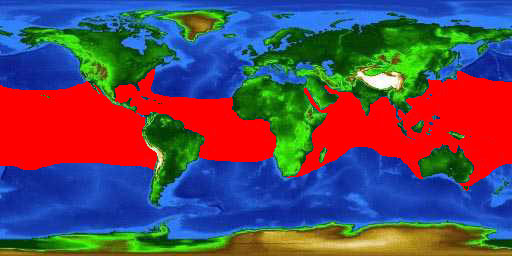
The whale shark has a very widespread distribution, occurring in all tropical and warm temperate seas, except in the Mediterranean. Information technology occurs throughout the Atlantic Ocean, from New York through the Caribbean to cardinal Brazil and from Senegal to the Gulf of Guinea. It also occurs in the Indian Sea, throughout the region, including the Crimson Sea and the Arabian Gulf. In the Pacific Body of water, it is found from Nippon to Australia, off Hawaii, and from California to Chile (Sequeira, 2013).
Habitat
In contrast to nearly sharks from the same club (Orectolobiformes), which are benthic (alive on or almost the bottom) species, the whale shark is a pelagic (open sea) species. Studies reveal that this shark tin can achieve depths of 1928 meters (6325.5 ft) (Tyminski, 2015) and prefers warm waters, with surface temperature effectually 21-30º C (69.8-86 F), marked by loftier primary productivity (plankton). They are frequently seen offshore but normally come shut inshore, sometimes inbound lagoons or coral atolls. This species segregates by size and sex in about of the coastal feeding areas. The coastal feeding sites consist of mainly juvenile male person sharks, with the largest congregation containing hundreds to thousands of individual sharks (Rohner, 2013). Whale sharks show site allegiance, where they continuously return to the same feeding site but are also highly migratory with daily movement of about 24-28 km (14.ix-17.4 miles) (McCoy, 2018). Their movements might be related to local productivity and they are often associated with schools of pelagic fish that are probably feeding on the aforementioned prey organisms.
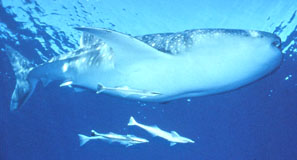
Dissimilar geographic locations appear to be preferred at diverse times of the year. Whale sharks alternatively may undertake either adequately localized or large-scale transoceanic migrations, the movements governed past the timing and location of production pulses and possibly by breeding behavior. Seasonal migrations have been postulated for various areas merely more information is needed to ostend these patterns. Each March and April, whale sharks are known to be amass on the continental shelf of the central western coast of Australia, particularly in the Ningaloo Reef area (Fitzpatrick, 2006). A study was done in this area to provide information on the short-term movements and behavior of this species of shark. Whale sharks are idea to migrate to Ningaloo Reef each year to take advantage of the high zooplankton concentrations (Martin, 2007).
A few whale sharks were tracked and some behavioral observations were fabricated while snorkeling in the surface area. The reaction of the sharks to snorkelers varied betwixt ignoring them to slowly diving. At times when water was flowing out from the reef lagoon, possibly transporting potential prey outside the reef, the tracked sharks swam in large circles adjacent to passes in the reef. The whale sharks as well fabricated numerous dives throughout the observation flow. It appears that these movements, up and downward through the water column, were associated with feeding (Gunn, 1999). Whale sharks have smaller livers than nearly sharks and could conceivably command their buoyancy by swallowing some air as do the sand tiger sharks (Ondontaspis taurus).
Whale sharks were also observed near La Paz, Mexico. Researchers reported that when these sharks were not feeding at the surface, they swam practically without the head-turning, gulping, and rhythmical opening and endmost of the gill slits, seen during feeding beliefs(Rowat, 2012). The oral cavity was held slightly open, and the peel over the gill openings was quivering as h2o flowed steadily out the gill slits in the typical ventilation of pelagic sharks (Rowat, 2012).
Because of the wide geographical range, two main sub-populations exist which vary slightly in population size and population tendency, Atlantic and Indo-Pacific (McKinney, 2017).
Distinguishing Characteristics
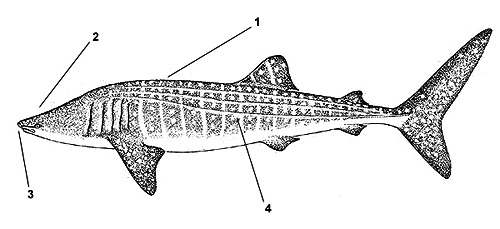
1. Back and sides marked with unique checkerboard pattern of light spots and transverse bars
2. Caput is broad and flat with a short snout
three. Oral fissure is virtually the tip of the snout
4. Sides have three prominent ridges
Biological science
Distinctive Features
A streamlined body and a depressed, broad, and flattened caput characterize the whale shark (Compagno, 2005). The rima oris is transverse, very large and well-nigh at the tip of the snout. Gill slits are very big, modified internally into filtering screens. The offset dorsal fin is much larger than the second dorsal fin, and set rearward on the body (Compagno, 2005). The two lobed caudal fin (tail) is semi-lunate in adults; in small juveniles the upper lobe is considerably longer than the lower lobe. The whale shark has a unique "checkerboard" color pattern of light spots and stripes on a nighttime groundwork (Compagno, 2005).
Coloration
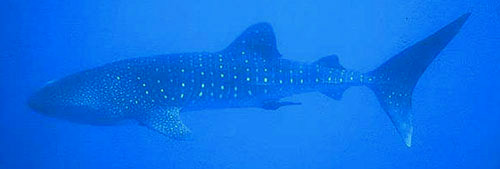
Whale sharks are grayish, bluish or brownish above, with an upper surface design of creamy white spots betwixt pale, vertical and horizontal stripes (Compagno, 2005). The belly is white. The function of the distinctive pattern of body mark is unknown. Many lesser-dwelling sharks accept bold and disruptive body markings that human action as camouflage through confusing coloration (Compagno, 2005). The whale shark'due south markings could be a result of its evolutionary relationship with bottom dwelling house carpet sharks. Distinctive markings in a pelagic species could be linked to social activities such as postural displays and recognition processes (Compagno, 2005).
Dentition
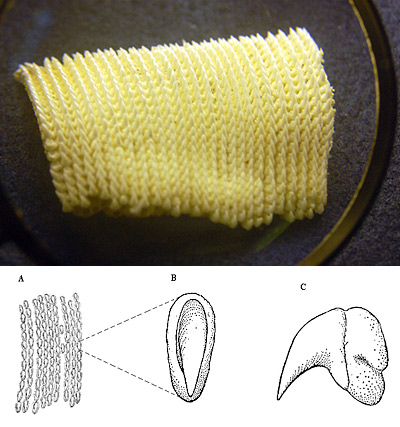
Inside of the oral fissure next to the pharynx, the shark has 20 filtering pads in full. (ten on each side, and then divided into upper and lower). These filtering pads allow the shark to sift through an average of 20,723 grams of plankton a twenty-four hour period (Motta, 2010).
Dermal Denticles
The whale shark has unique denticles (tooth-similar scales structures), each with an extremely stiff central keel, no lateral keels, and a tri-lobed rear margin. It would appear that the denticles are hydrodynamically of import in its pelagic lifestyle (Martin, 2007).
Size, Age & Growth
The whale shark is the largest living fish with the maximum size thought to be virtually 20m. The smallest free-living individuals are from 55cm (21.7 in.) long (Compagno, 2005). The size of these sharks at maturity is yet being researched, but studies indicate that both male and female sharks achieve maturity by 9m (29.5 ft) long (Colman, 1997). Age estimates for whale sharks are equally loftier as 60 years, but no one really knows how long this species lives.
Food Habits
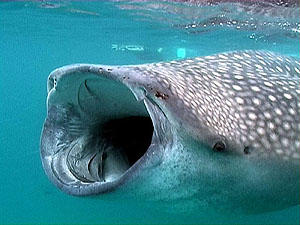
Whale sharks feed on a wide diverseness of planktonic (microscopic) and nektonic (larger costless-swimming) casualty, such as small-scale crustaceans, schooling fishes, and occasionally on tuna and squids (Martin, 2007). Also, phytoplankton (microscopic plants) and macroalgae (larger plants) may course a component of the diet. Dissimilar most plankton feeding vertebrates, they exercise not depend on deadening forward motion to filter, rather, they rely on a versatile suction filter-feeding method, which enables them to describe h2o into the mouth at higher velocities than other dynamic filter-feeders, similar the basking shark. This enables the whale shark to capture larger more than active nektonic casualty as well as zooplankton aggregations (Motta, 2010).
Therefore, they are dependent on dense aggregations of prey organisms. The denser filter screens are efficient filters for brusque suction intakes, in contrast to the flow through systems of basking shark. Whale sharks are always seen feeding passively in a vertical or most vertical position with the caput at or nearly the surface (Motta, 2010).
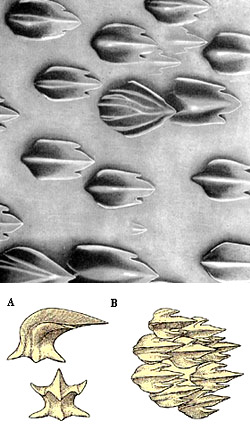
The whale shark feeds actively by opening its mouth, distending the jaws and sucking. Then it closes its mouth and the water flows out its gills. During the slight delay between closing the mouth and opening the gill flaps, plankton may be trapped against the dermal denticles lining the gill plates and pharynx (Motta, 2010). The fine sieve-like appliance, a unique modification of the gill rakers, forms an obstruction to the passage of annihilation but fluid, retaining all organisms above 2 to 3mm (.07- .12 inches) in diameter. Practically nothing just water goes through this sieve. Individuals have also been observed cough, a mechanism that is idea to be employed to clear or flush the gill rakers of accumulated food particles (Motta, 2010).
Whale sharks move their heads from side to side, vacuuming in seawater rich in plankton, or aggressively cut swathes through schools of casualty. Groups of individuals have been observed feeding at dusk or afterward dark (Martin, 2007). The density of plankton probably is sensed by the well-developed nostrils, located on either side of the upper jaw, on the leading edge of the terminal oral cavity. The frequent turns may keep the whale sharks in the denser parts of the plankton patches, searching and scanning when an olfactory cue weakens on one side or the other (Martin, 2007).
The whale shark's minor eyes are located on the sides of the caput. Because of this, vision may play a much smaller role than olfaction in directing the head turns during surface feeding. One live whale shark pup removed from its dead mother was maintained in captivity in Japan. It did not consume for the get-go 17 days, even though it swam constantly. This suggests that the pup had substantial stores of endogenous (stored) energy (Chang, 1997).
Reproduction
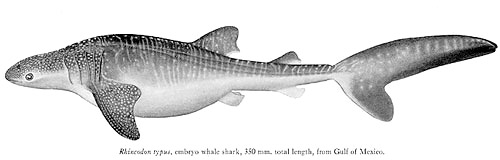
Historically, there was a swell scientific argue about the mode of development of whale sharks. Yet, in 1995, an eleven-meter female whale shark was harpooned off the eastern coast of Taiwan and 300 fetal specimens, ranging in length from 42 to 63cm, were taken from the ii uteri (Compagno 2005). This discovery proved that the species is a live bearer, with an ovoviviparous (egg cases hatching in the mother'due south uteri, with the female giving birth to live young) mode of evolution.
The egg-capsules of this whale shark were amber colored, with a polish texture, and possessed a respiratory fissure (opening) on each side (Chang, 1997). The sex activity ratio was approximately one:1. It would appear that female whale sharks requite birth as they feed in the rich waters of the Kuroshio Current. It is likewise credible that the southeast waters off Taiwan are an important birthing surface area during summertime months. It is believed that the young measure out 55-64 cm (21.7-25.2 in.) full length at nascence (Chang, 1997).
Predators
A juvenile specimen was found in the tum of a bluish shark (Prionace glauca). Another specimen was found in the gut contents of a bluish marlin (Makaira nigricans).
At Ningaloo Reef, not bad white sharks (Carcharodon carcharias), and tiger sharks (Galeocerdo cuvier) have been reported to assail whale sharks when they congregate (Fitzpatrick, 2006).
Parasites
Many parasitic copepods were found on the lining of the pharynx of a small-scale (60cm total length) whale shark from Taiwan.
Taxonomy
The whale shark was first described and named past Andrew Smith in 1828, based on a specimen harpooned in Table Bay, South Africa. Historically, there take been many synonyms (culling scientific names) for family unit, genus and species names. The first scientific printing of the genus name appeared as Rincodon, despite Smith'due south desired name of Rhineodon. Nevertheless, in 1984 the International Commission on Zoological Nomenclature suppressed previous generic variations in favor of genus proper noun Rhincodon, and the family name Rhincodontidae. Others generic names formerly used includeRhiniodon and Rhineodon and the family names Rhiodontidae and Rhineodontidae. Systematically, Rhincodontidae is placed in the order Orectolobiformes, which also includes families such every bit Ginglymostomatidae (nurse sharks) and Orectolobidae (wobbegongs). The interrelationships between these families are based on anatomical and morphological similarities.
Synonyms for the whale shark in past scientific literature include Rhinodon typicus Müller & Henle 1839, Rhinodon typicusSmith 1845, Micristodus punctatus Gill 1865, and Rhinodon pentalineatus Kishinouye 1901.
Rhincodon typus is derived from the Greek words "rhyngchos" = rasp and "odous" = tooth. The species name is translated as blazon.
Revised by Macey Sigel and Tyler Bowling 2020
Prepared by: Carol Martins & Craig Knickle
References
- Akhilesh, Grand.5., Shanis, C.P.R., White, W.T., Manjebrayakath, H., Bineesh, K.K., Ganga, U., Abdussamad, E.M., Gopalakrishnan, A. and Pillai, N.G.K., 2013. Landings of whale sharks Rhincodon typus Smith, 1828 in Indian waters since protection in 2001 through the Indian Wildlife (Protection) Act, 1972.Environmental biology of fishes,96(6), pp.713-722.
- Castro, A.50.F., Stewart, B.Southward., Wilson, S.G., Hueter, R.E., Meekan, K.G., Motta, P.J., Bowen, B.W. and Karl, Due south.A., 2007. Population genetic structure of Earth'due south largest fish, the whale shark (Rhincodon typus).Molecular Ecology,16(24), pp.5183-5192.
- Chang, W.B., Leu, M.Y. and Fang, L.S., 1997. Embryos of the whale shark, Rhincodon typus: early growth and size distribution. Copeia, 1997(two), pp.444-446.
- Chen, C.T., Liu, M.Chiliad. and Joung, S.J., 2002. Preliminary report on Taiwan'southward whale shark fishery. InElasmobranch Biodiversity, Conservation and Management: Proceedings of the International Seminar and Workshop, Sabah, Malaysia, July 1997 (pp. 162-167). IUCN Gland, Switzerland.
- Colman, J.Grand., 1997. A review of the biological science and environmental of the whale shark. J. Fish Biol. 1997(51) pp. 1219-1234
- Compagno, L., Dando, M. and Fowler, S., 2005. A field guide to the sharks of the earth.
- Fitzpatrick, B., Meekan, M. and Richards, A., 2006. Shark attacks on a whale shark (Rhincodon typus) at Ningaloo Reef, Western Commonwealth of australia. Bulletin of Marine Scientific discipline, 78(2), pp.397-402.
- Gunn, J.S., Stevens, J.D., Davis, T.L.O. and Norman, B.M., 1999. Observations on the brusk-term movements and behaviour of whale sharks (Rhincodon typus) at Ningaloo Reef, Western Commonwealth of australia.Marine Biological science,135(three), pp.553-559.
- Martin, R.A., 2007. A review of behavioural ecology of whale sharks (Rhincodon typus). Fisheries Research, 84(1), pp.10-sixteen.
- McCoy, E., Burce, R., David, D., Aca, East.Q., Hardy, J., Labaja, J., Snow, S.J., Ponzo, A. and Araujo, G., 2018. Long-term photograph-identification reveals the population dynamics and potent site fidelity of adult whale sharks to the coastal waters of Donsol, Philippines.Frontiers in Marine Science,5, p.271.
- McKinney, J.A., Hoffmayer, Due east.R., Holmberg, J., Graham, R.T., Driggers Three, West.B., de la Parra-Venegas, R., Galván-Pastoriza, B.E., Flim-flam, S., Pierce, South.J. and Pigeon, A.D., 2017. Long-term assessment of whale shark population demography and connectivity using photo-identification in the Western Atlantic Ocean.PloS ane,12(8), p.e0180495.
- Meekan, M.One thousand., Bradshaw, C.J., Printing, M., McLean, C., Richards, A., Quasnichka, S. and Taylor, J.G., 2006. Population size and structure of whale sharks Rhincodon typus at Ningaloo Reef, Western Commonwealth of australia.Marine Ecology Progress Series,319, pp.275-285.
- Motta, P.J., Maslanka, Yard., Hueter, R.East., Davis, R.L., De la Parra, R., Mulvany, South.L., Habegger, 1000.Fifty., Strother, J.A., Mara, Thousand.R., Gardiner, J.M. and Tyminski, J.P., 2010. Feeding anatomy, filter-feeding rate, and diet of whale sharks Rhincodon typus during surface ram filter feeding off the Yucatan Peninsula, Mexico. Zoology, 113(4), pp.199-212.
- Rohner, C.A., Pierce, Southward.J., Marshall, A.D., Weeks, South.J., Bennett, 1000.B. and Richardson, A.J., 2013. Trends in sightings and environmental influences on a coastal aggregation of manta rays and whale sharks.Marine Environmental Progress Series,482, pp.153-168.
- Rowat, D. and Brooks, G.Southward., 2012. A review of the biological science, fisheries and conservation of the whale shark Rhincodon typus. Journal of fish biological science, eighty(5), pp.1019-1056.
- Sequeira, A.M., Mellin, C., Meekan, M.G., Sims, D.West. and Bradshaw, C.J., 2013. Inferred global connectivity of whale shark Rhincodon typus populations.Journal of Fish Biology,82(2), pp.367-389.
- Stacey, Northward.E., Karam, J., Meekan, M.Thousand., Pickering, S. and Ninef, J., 2012. Prospects for whale shark conservation in Eastern Republic of indonesia through bajo traditional ecological knowledge and community-based monitoring.Conservation and Club,10(1), p.63.
- Topelko, K.N. and Dearden, P., 2005. The shark watching manufacture and its potential contribution to shark conservation.Journal of Ecotourism,4(2), pp.108-128.
- Tyminski, J.P., de la Parra-Venegas, R., Cano, J.G. and Hueter, R.E., 2015. Vertical movements and patterns in diving behavior of whale sharks as revealed by popular-upwards satellite tags in the eastern Gulf of Mexico.PloS one,x(11), p.e0142156.
tylorhicaltisee38.blogspot.com
Source: https://www.floridamuseum.ufl.edu/discover-fish/species-profiles/rhincodon-typus/

Post a Comment for "Is a Baby Ray's From Visiting Is There a Baby Whale Shark Bigger Than a Great White Shark"