When Reading a Graduated Cylinder, From What Part of the Liquid Should You Measure
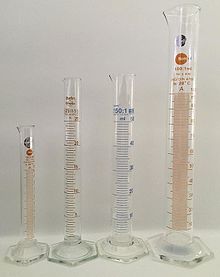
Unlike types of graduated cylinder: 10mL, 25mL, 50mL and 100mL graduated cylinder

A graduated Measuring Cylinder with a plastic Stopper
A graduated cylinder, as well known every bit a measuring cylinder or mixing cylinder is a common piece of laboratory equipment used to measure out the volume of a liquid. It has a narrow cylindrical shape. Each marked line on the graduated cylinder represents the corporeality of liquid that has been measured.
Materials and structure [edit]
Large graduated cylinders are usually made of polypropylene for its excellent chemical resistance or polymethylpentene for its transparency, making them lighter and less fragile than glass. Polypropylene (PP) is easy to repeatedly autoclave; nevertheless, autoclaving in backlog of most 121 °C (250 °F) (depending on the chemic formulation: typical commercial course polypropylene melts in excess of 177 °C (351 °F)), can warp or impairment polypropylene graduated cylinders, affecting accuracy.[1]
A traditional graduated cylinder is usually narrow and tall so as to increase the accurateness and precision of volume measurement. It has a plastic or glass base (stand, foot, support) and a "spout" for easy pouring of the measured liquid. An boosted version is wide and low.
Mixing cylinders have footing glass joints instead of a spout, so they can be closed with a stopper or connect direct with other elements of a manifold.[2] With this kind of cylinder, the metered liquid does not pour directly, simply is often removed using a Cannula. A graduated cylinder is meant to exist read with the surface of the liquid at eye level, where the middle of the meniscus shows the measurement line. Typical capacities of graduated cylinders are from 10 mL to 1000 mL.
Common uses [edit]
Graduated cylinders are oft used to measure out the volume of a liquid. Graduated cylinders are generally more accurate and precise than laboratory flasks and beakers, merely they should not be used to perform volumetric assay;[3] volumetric glassware, such as a volumetric flask or volumetric pipette, should be used, equally it is even more accurate and precise. Graduated cylinders are sometimes used to measure out the volume of a solid indirectly by measuring the displacement of a liquid.
Scales and accuracy [edit]
For accuracy the volume on graduated cylinders is depicted on scales with 3 pregnant digits: 100mL cylinders have 1ml grading divisions while 10mL cylinders have 0.one mL grading divisions.
Two classes of accuracy be for graduated cylinders. Class A has double the accuracy of class B.[4] Cylinders can have single or double scales. Single scales allow to read the volume from top to bottom (filling volume) while double scale cylinders allow reading for filling and pouring (opposite scale).
Graduated cylinders are calibrated either "to incorporate" (indicated liquid volume inside the cylinder) and marked equally "TC" or "to deliver" (indicated liquid volume poured out, accounting for liquid traces left in the cylinder) and marked "TD".[v] Formerly the tolerances for "to deliver" and "to contain" cylinders are distinct; all the same now these are the same. As well, the international symbols "IN" and "EX" are more probable to exist used instead of "TC" and "TD" respectively.[vi]
Measurement [edit]

If the reading is done and the value calculated is prepare to be 40.0 mL. The precise value would exist twoscore.0 ± 0.1 or xl.1 to 39.9 mL

If the reading is done and the value calculated is set to be 36.5 mL. The more precise value equates to 36.v 0.5 mL or 36.0 to 37.0 mL.

To read the book accurately, the observation must exist at an eye level and read at the lesser of a meniscus of the liquid level.[vii] The primary reason equally to why the reading of the volume is done via meniscus is due to the nature of the liquid in a closed surrounded space. By nature, liquid in the cylinder would be attracted to the wall around it through molecular forces. This forces the liquid surface to develop either a convex or concave shape, depending on the type of the liquid in the cylinder. Reading the liquid at the bottom part of a concave or the summit part of the convex liquid is equivalent to reading the liquid at its meniscus.[8] From the picture, the level of the liquid will be read at the bottom of the meniscus, which is the concave. The most accurate of the reading that could exist done here is reduced down to 1 mL due to the given means of measurement on the cylinder. From this, the derived fault would be one tenth of the least figure. For example, if the reading is done and the value calculated is set to exist 36.5 mL. The fault, give or take 0.i mL, must be included too. Therefore, the more than precise value equates to 36.v 0.1; 36.4 or 36.half dozen mL. Therefore, there are 3 significant figures can exist read from the given graduated cylinder motion-picture show.[nine] Another example, if the reading is done and the value calculated is prepare to be 40.0 mL. The precise value would be 40.0 0.1; xl.1 or 39.9 mL.[10]
Additional images [edit]
-

2 graduated cylinders. A traditional graduated cylinder (A in the image), and mixing cylinders (B in the picture)
References [edit]
- ^ "Graduated Cylinders - SPI Supplies". www.2spi.com . Retrieved 2020-02-20 .
- ^ http://www.elementalscientific.net/store/scripts/prodView.asp?idproduct=1239 Retrieved 20 Feb 2020
- ^ Pradyot Patnaik (2003). "Specifications for volumetric ware". Dean's Handbook of Analytical Chemistry, 2nd Edition. McGraw-Loma. ISBN978-0071410601.
- ^ "ASTM E1272 - 02(2019) Standard Specification for Laboratory Glass Graduated Cylinders".
- ^ "Graduated Cylinders Information".
- ^ "Graduated Cylinders". sizes.com . Retrieved 2016-02-23 .
- ^ "graduated cylinder" (PDF). ohlone.edu. Archived from the original (PDF) on 2015-06-26. Retrieved 2015-06-25 .
- ^ "Volume Measurements with a Graduated Cylinder" (PDF). Archived from the original (PDF) on 2016-02-16. Retrieved 2016-02-04 .
- ^ "Math Skills - Scientific Notation". www.chem.tamu.edu . Retrieved 2016-02-12 .
- ^ Robinson, Michael; Robinson, Mike; Taylor, Mike (2002-01-01). Maths for Advanced Chemical science. Nelson Thornes. ISBN9780748765829 . Retrieved 15 March 2016.
tylorhicaltisee38.blogspot.com
Source: https://en.wikipedia.org/wiki/Graduated_cylinder

Post a Comment for "When Reading a Graduated Cylinder, From What Part of the Liquid Should You Measure"