Born Again Christian Population in the World

A comprehensive demographic report of more 200 countries finds that at that place are 2.eighteen billion Christians of all ages effectually the world, representing nearly a tertiary of the estimated 2010 global population of 6.ix billion. Christians are also geographically widespread – then far-flung, in fact, that no unmarried continent or region can indisputably claim to be the centre of global Christianity.
A century agone, this was not the case. In 1910, well-nigh ii-thirds of the globe's Christians lived in Europe, where the bulk of Christians had been for a millennium, according to historical estimates by the Heart for the Study of Global Christianity.2 Today, only about a quarter of all Christians alive in Europe (26%). A plurality – more than a third – now are in the Americas (37%). About one in every four Christians lives in sub-Saharan Africa (24%), and about one-in-viii is found in Asia and the Pacific (13%).
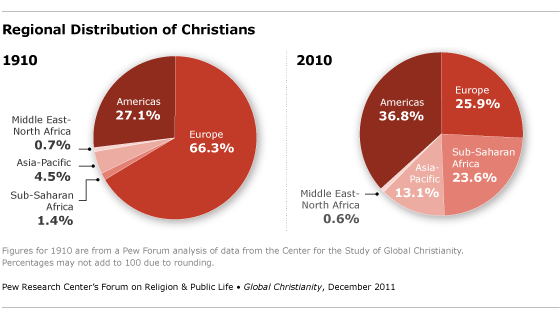
The number of Christians around the globe has nearly quadrupled in the last 100 years, from about 600 million in 1910 to more than two billion in 2010. Just the globe'due south overall population also has risen rapidly, from an estimated i.viii billion in 1910 to 6.9 billion in 2010. Equally a result, Christians brand up about the aforementioned portion of the world'southward population today (32%) equally they did a century agone (35%).
This apparent stability, still, masks a momentous shift. Although Europe and the Americas still are domicile to a majority of the world's Christians (63%), that share is much lower than it was in 1910 (93%). And the proportion of Europeans and Americans who are Christian has dropped from 95% in 1910 to 76% in 2010 in Europe every bit a whole, and from 96% to 86% in the Americas as a whole.

At the same time, Christianity has grown enormously in sub-Saharan Africa and the Asia-Pacific region, where there were relatively few Christians at the beginning of the 20th century. The share of the population that is Christian in sub-Saharan Africa climbed from 9% in 1910 to 63% in 2010, while in the Asia-Pacific region it rose from iii% to 7%. Christianity today – different a century ago – is truly a global faith. (Run across world maps weighted by Christian population in 1910 and 2010.)
These are some of the key findings of Global Christianity: A Report on the Size and Distribution of the World'southward Christian Population, a new study past the Pew Research Center's Forum on Religion & Public Life.
The report is based primarily on a country-past-state assay of near 2,400 data sources, including censuses and nationally representative population surveys. For some countries, such as Communist china, the Pew Forum's estimates also take into account statistics from church groups, authorities reports and other sources. (Come across Appendix C [PDF] for more than details on the range of estimates available for China.)
Christians are diverse theologically besides equally geographically, the new written report finds. About one-half are Cosmic. Protestants, broadly defined, make up 37%. Orthodox Christians comprise 12% of Christians worldwide. Other Christians, such as Mormons and Jehovah's Witnesses, make up the remaining 1% of the global Christian population. (See Defining Christian Traditions.)
Taken as a whole, however, Christians are by far the world's largest religious group. Muslims, the second-largest group, brand upwards a little less than a quarter of the world's population, co-ordinate to previous studies by the Pew Forum.3
Nearly half (48%) of all Christians live in the x countries with the largest number of Christians. Three of the top 10 countries are in the Americas (the United States, Brazil and Mexico). Two are in Europe (Russia and Germany), 2 are in the Asia-Pacific region (the Philippines and China), and three are in sub-Saharan Africa (Nigeria, Democratic Republic of the congo and Federal democratic republic of ethiopia), reflecting Christianity's global attain.
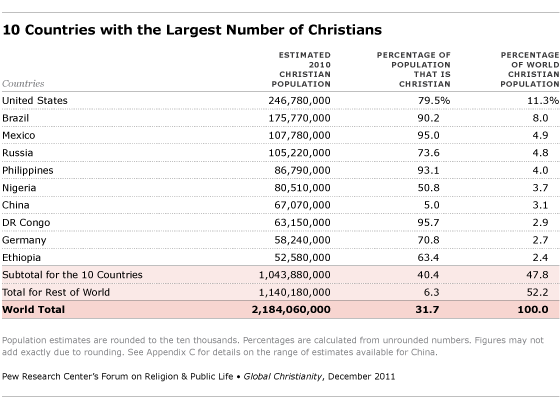

Conspicuously, Christianity has spread far from its historical origins. For example:
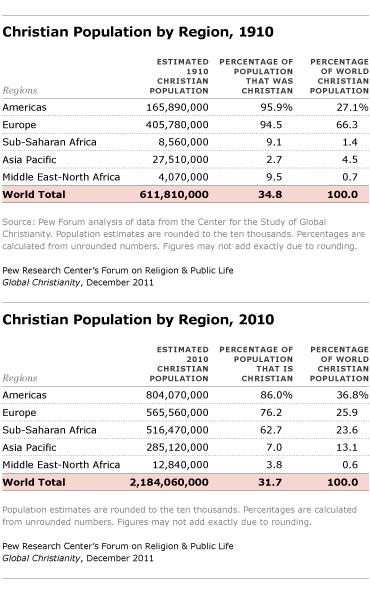
- Though Christianity began in the Center E-Due north Africa, today that region has both the everyman concentration of Christians (about 4% of the region'due south population) and the smallest number of Christians (about 13 million) of any major geographic region.
- Indonesia, a Muslim-majority state, is home to more Christians than all 20 countries in the Middle Eastward-North Africa region combined.
- Nigeria now has more than twice equally many Protestants (broadly defined to include Anglicans and independent churches) as Germany, the birthplace of the Protestant Reformation.
- Brazil has more than twice as many Catholics as Italia.
- Although Christians contain only nether a third of the world's people, they form a majority of the population in 158 countries and territories, about two-thirds of all the countries and territories in the globe.
- Well-nigh 90% of Christians live in countries where Christians are in the bulk; just well-nigh 10% of Christians worldwide live as minorities.
Global Distribution of Christians
Then where are the majority of the world'due south Christians today? The Pew Forum study suggests at least four possible answers, depending on how one divides up the world:
The Global Due south
In recent years, a number of scholarly books and articles have discussed the rapid growth of Christianity in the developing countries of the "Global South" – especially Africa, Asia and Latin America – and debated whether the influence of Christians in the "Global N" is waning, or not.4 A century ago, the Global Northward (normally divers as North America, Europe, Australia, Japan and New Zealand) contained more than four times as many Christians as the Global South (the rest of the globe).v Today, the Pew Forum written report finds, more than ane.3 billion Christians alive in the Global South (61%), compared with about 860 million in the Global N (39%).
The Global North
Simply even though Christians are more numerous in the Global South, the concentration of Christians is much college in the Global North, where 69% of the population is Christian. Past contrast, 24% of the people living in the Global South are Christian. This reflects the fact that the total population of the Global S is about four.five times greater than the population of the Global North.

Some other way of looking at the distribution of Christians around the world is by region. Numerically, at least, Europe no longer dominates global Christianity the fashion it did 100 years agone. Rather, the bulk of Christians are in:
The Americas
Of the world's v major geographic regions, the Americas have both the largest number and the highest proportion of Christians. More than a third of Christians worldwide (37%) live in the Americas, where nigh nine-in-ten people (86%) are Christian. The three countries with the largest Christian populations – the United states of america, Brazil and Mexico – are in the Americas. Together, these three countries alone account for about one in every four Christians in the earth (24%), about the same proportion every bit the whole of Europe (26%) and all of sub-Saharan Africa (24%). Although Christians make upwardly a smaller portion of the 2010 population in the Americas (86%) than they did in 1910 (96%), the Americas business relationship for a higher share of the globe'south Christians (37%, up from 27% in 1910).half-dozen
Sub-Saharan Africa and Asia-Pacific
Simply sub-Saharan Africa and the Asia-Pacific region now have a combined population of near 800 million Christians, roughly the same equally the Americas. And five of the top 10 countries with the largest Christian populations are either in Africa (Nigeria, Democratic republic of the congo and Federal democratic republic of ethiopia) or Asia (Philippines and China). Moreover, the fastest growth in the number of Christians over the by century has been in sub-Saharan Africa (a roughly sixty-fold increment, from fewer than 9 meg in 1910 to more than 516 1000000 in 2010) and in the Asia-Pacific region (a roughly 10-fold increase, from about 28 one thousand thousand in 1910 to more than than 285 million in 2010).
How Estimates Were Generated
The Pew Forum, in consultation with demographers at the International Plant for Applied Systems Analysis (IIASA) in Laxenburg, Austria, caused and analyzed near 2,400 data sources, including censuses and full general population surveys, to arrive at Christian population figures for 232 countries and self-administering territories – all the countries and territories for which the United Nations Population Segmentation provides overall population estimates. (Run into Appendix A [PDF] for a more detailed explanation of how the estimates were made; see Appendix D [PDF] for a list of information sources by country.)

In many countries, all the same, censuses and surveys do not incorporate detailed information on denominational and religious movement affiliations. Christian organizations remain in many cases the simply source of data on the size of global movements inside Christianity (such as evangelicalism and pentecostalism) and on Protestant denominational families (such as Baptists and Methodists). The figures in this report on pentecostal, charismatic and evangelical Christians and on Protestant denominational families were commissioned past the Pew Forum from the Center for the Written report of Global Christianity at Gordon-Conwell Theological Seminary in South Hamilton, Mass., whose researchers generated estimates based in big part on figures provided by Christian organizations around the world. Readers should behave in mind that these breakdowns were derived differently from the overall Christian population estimates.

Co-ordinate to the Center for the Study of Global Christianity, in that location are about 279 million pentecostal Christians and 305 one thousand thousand charismatic Christians worldwide. (Charismatic Christians belong to non-pentecostal denominations nevertheless engage in spiritual practices associated with pentecostalism, such every bit speaking in tongues and divine healing; see Defining Christian Movements.)
In add-on, more than 285 million Christians tin be classified as evangelicals because they either vest to churches affiliated with regional or global evangelical associations, or because they identify every bit evangelicals. Since many pentecostals and charismatics are also evangelicals, these categories are not mutually exclusive. (For more details, meet Christian Movements and Denominations.)
Footnotes:
2 Historical figures throughout the executive summary are courtesy of Todd K. Johnson of the Center for the Study of Global Christianity at Gordon-Conwell Theological Seminary in South Hamilton, Mass. Johnson is co-editor of the Atlas of Global Christianity, Edinburgh University Printing, 2009. (return to text)
3 Every bit of 2010, there were about ane.half-dozen billion Muslims worldwide, representing 23.four% of the global population. For more details, encounter the Pew Inquiry Center's Forum on Religion & Public Life, The Future of the Global Muslim Population: Projections for 2010-2030, January 2011, and Pew Research Middle'due south Forum on Religion & Public Life, Mapping the Global Muslim Population: A Report on the Size and Distribution of the Globe'due south Muslim Population, October 2009. Every bit noted in the preface of this report, the Pew Forum is gradually compiling baseline population estimates and projecting future growth rates for the world's major faiths. (return to text)
4 Run into, for example, Philip Jenkins, The Next Christendom: The Coming of Global Christianity, Oxford University Printing, 2002; Robert Wuthnow, Boundless Religion: The Global Outreach of American Churches, University of California Press, 2009; and Marking A. Noll, The New Shape of Globe Christianity: How American Experience Reflects Global Faith, InterVarsity Press, 2009. (return to text)
5 This common definition of Global North and Global Southward is not a simple geographic segmentation of the earth into Northern and Southern hemispheres. Rather, it takes into account levels of economical development as well as geography. Figures for 1910 are from a Pew Forum assay of data from the Center for the Study of Global Christianity. (return to text)
half dozen Figures for 1910 are from a Pew Forum analysis of data from the Centre for the Written report of Global Christianity. (render to text)
tylorhicaltisee38.blogspot.com
Source: https://www.pewforum.org/2011/12/19/global-christianity-exec/

Post a Comment for "Born Again Christian Population in the World"