How Can You Write the Expression With Rationalized Denominator 2+sqrt 5/2-sqrt 5
 Download Commodity
Download Article
Traditionally, a radical or irrational number cannot exist left in the denominator (the bottom) of a fraction. When a radical does appear in the denominator, you demand to multiply the fraction by a term or set of terms that can remove that radical expression. While the use of calculators brand rationalizing fractions a chip dated, this technique may notwithstanding exist tested in class.
-
1
Examine the fraction. A fraction is written correctly when there is no radical in the denominator. If the denominator contains a foursquare root or other radical, you must multiply both the top and bottom by a number that can get rid of that radical. Notation that the numerator tin contain a radical. Don't worry near the numerator.[ane]
-
2
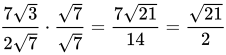
Multiply the numerator and denominator past the radical in the denominator. A fraction with a monomial term in the denominator is the easiest to rationalize. Both the top and bottom of the fraction must exist multiplied by the same term, because what you lot are actually doing is multiplying past 1.
Advertisement
-
3
Simplify as needed. The fraction has now been rationalized.[two]
Advert

-
one
Examine the fraction. If your fraction contains a sum of ii terms in the denominator, at least 1 of which is irrational, so you cannot multiply the fraction past it in the numerator and denominator.[three]
-
2
Multiply the fraction by the cohabit of the denominator. The conjugate of an expression is the same expression with the sign reversed.[4] For case, the conjugate of is
-
three
Simplify as needed. [5]
Advertisement



-
1
Examine the trouble. If you are asked to write the reciprocal of a set of terms containing a radical, you lot will need to rationalize before simplifying. Use the method for monomial or binomial denominators, depending on whichever applies to the problem.[vi]
-
2
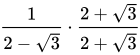
Write the reciprocal equally it would commonly announced. A reciprocal is created when you capsize the fraction.[7] Our expression is actually a fraction. It'due south just being divided by one.
-
3
Multiply by something that tin can go rid of the radical on the lesser. Remember, you lot're actually multiplying by 1, so you have to multiply both the numerator and denominator. Our example is a binomial, so multiply the acme and bottom by the cohabit.[8]
-
4
Simplify equally needed.
- Do non exist thrown off by the fact that the reciprocal is the conjugate. This is simply a coincidence.
Advertising



-
1
Examine the fraction. You lot tin as well look to face cube roots in the denominator at some betoken, though they are rarer. This method besides generalizes to roots of any index.
-
2
Rewrite the denominator in terms of exponents. Finding an expression that will rationalize the denominator hither volition exist a bit different because we cannot simply multiply by the radical.[9]
-
3
Multiply the top and bottom by something that makes the exponent in the denominator 1. In our case, we are dealing with a cube root, and so multiply by Remember that exponents turn a multiplication trouble into an addition problem by the holding [10]
-
4
Ad
![{\frac {3}{{\sqrt[ {3}]{3}}}}](https://wikimedia.org/api/rest_v1/media/math/render/svg/3a37ab9394065e1be3dca1eeb4e96021d86c08a2)


Add together New Question
-
Question
How do I rationalize with 3 terms?

Something like 1/(1+root2 + root3)? If so, group as ane+(root2 + root3) and multiply through by the "divergence of squares conjugate" 1-(root2 + root3). That makes the denominator -4 - root6, which is still irrational, but did amend from two irrational terms to but one. So repeat the aforementioned trick by multiplying through by -4+root6 and the denominator is rationalized.
-
Question
In your pictures, what does the betoken mean?

If you lot're asking about the dots that are placed between various fractions, those are multiplication signs. For example, in the article's second image we meet (vii√3) / (2√vii), so a dot, then (√7 / √vii). That means nosotros multiply the kickoff fraction by the 2nd fraction (numerator times numerator, and denominator times denominator), giving united states (vii√21) / fourteen, which simplifies to √21 / two. (Incidentally, the article shows some other dots that are not between fractions. Those are merely "bullet points.")
-
Question
How tin can I rationalize the denominator with a cube root that has a variable?

If it is a binomial expression, follow the steps outlined in method 2.
-
Question
How do yous rationalize a cube root in the denominator for a question like 1/(cube root five- cube root 3)?

This is a little trickier, but can be done. Multiply top and bottom by (cuberoot 25 + cuberoot fifteen + cuberoot 9) and the denominator simplifies to 2. This trick is coordinating to the quadratic case since it uses the difference of cubes factorization of v-iii, whereas the quadratics use the difference of squares factorization.


Ask a Question
200 characters left
Include your email accost to get a bulletin when this question is answered.
Submit
Advertisement
Thanks for submitting a tip for review!
Almost This Commodity
Article Summary X
To rationalize a denominator, start by multiplying the numerator and denominator by the radical in the denominator. And so, simplify the fraction if necessary. If you lot're working with a fraction that has a binomial denominator, or two terms in the denominator, multiply the numerator and denominator by the conjugate of the denominator. To get the cohabit, just reverse the sign in the expression. Then, simplify your answer as needed. To learn how to rationalize a denominator with a cube root, scroll down!
Did this summary aid yous?
Thanks to all authors for creating a page that has been read 91,316 times.
Did this article help you?
tylorhicaltisee38.blogspot.com
Source: https://www.wikihow.com/Rationalize-the-Denominator

Post a Comment for "How Can You Write the Expression With Rationalized Denominator 2+sqrt 5/2-sqrt 5"